
Having spent 20 years in the localization industry, I have witnessed every technological leap from floppy disk deliveries to cloud-based collaboration. Yet, as we stand on the threshold of 2026, facing the volatility of Web3 and the exponential evolution of AI, our entire industry is facing a stress test like never before.
Traditional localization services are like a Michelin-starred restaurant: exquisite craftsmanship, but slow service. Today’s clients—especially in Crypto, FinTech, and fast-paced Consumer Electronics—demand fast-food speed, Michelin quality, and street-food pricing.
This seems like a classic business "Impossible Triangle" (or Iron Triangle). As the CEO of Translia, after serving numerous Fortune 500 companies and iterating through countless workflows, my conclusion is clear: Relying solely on scaling headcount is obsolete. The only way to break this triangle is by reconstructing the "Middleware of Human-AI Collaboration."
1. Abandoning the "Reinvent the Wheel" Obsession: The Middleware Strategy
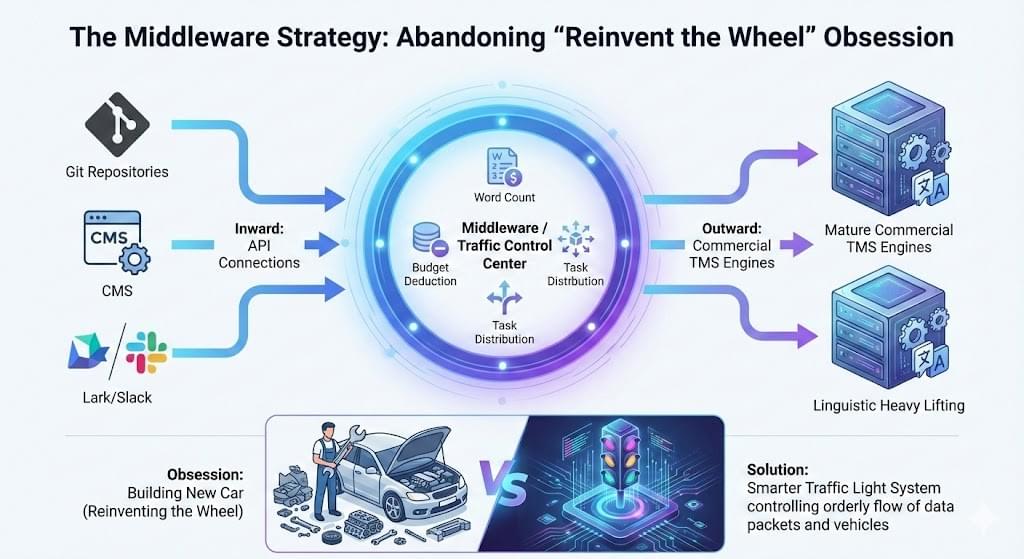
Many rapidly expanding enterprises have an obsession: building a proprietary Translation Management System (TMS) from scratch.
I understand the impulse. Generic tools often fail to fit complex internal workflows perfectly. However, drawing from my experience in patenting a collaborative translation system at Translia, building a full-featured CAT (Computer-Assisted Translation) editor from scratch is a massive resource black hole.
The solution for the future is not a binary "Build vs. Buy," but a "Middleware Strategy."
We need to build a lightweight "Traffic Control Center":
- Inward: It connects via API to Git repositories, CMS, or Lark/Slack to automatically fetch fragmented requests.
- Outward: It leverages mature commercial TMS engines for the heavy linguistic lifting.
- Automation: It automates word counts, budget deduction, and task distribution.
Instead of building a new car, build a smarter traffic light system. This is the ultimate path to cost reduction and efficiency.
2. When ISO Meets RAG: Airbags for High-Speed Delivery
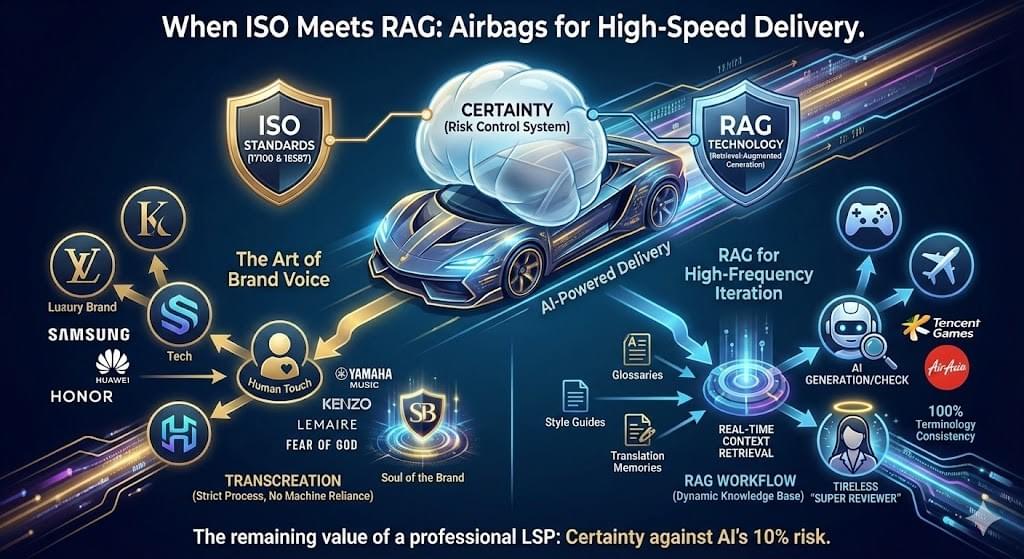
In an era where anyone can use an LLM to translate a paragraph, what is the remaining value of a professional Language Service Provider (LSP)? The answer is: Certainty.
AI can give you 90% perfection, but the remaining 10% can cause a compliance disaster or a PR crisis. At Translia, we implement ISO 17100 (Translation Services) and ISO 18587 (Post-editing) certifications not for the certificate itself, but to establish a "Risk Control System for the AI Era."
This system relies on tiered delivery and dynamic quality assurance tailored to specific verticals:
- The Art of Brand Voice: For Consumer Electronics giants, or Luxury brands, text is not just information; it is the extension of the brand's soul. Here, we do not rely solely on machines. We enforce strict "Transcreation" processes, ensuring every tagline resonates with luxury and technological sophistication.
- RAG for High-Frequency Iteration: The Gaming industry and Airlines share a common pain point: rapid updates with zero tolerance for error. We utilize RAG (Retrieval-Augmented Generation) technology—similar to the workflow used in Google NotebookLM—to transform massive glossaries, style guides, and translation memories into a dynamic knowledge base. When AI generates or checks translations, it retrieves context from this base in real-time. It’s like equipping every linguist with a tireless "Super Reviewer," ensuring 100% terminology consistency across millions of words.
3. The Shift: From CEO to Ops Architect
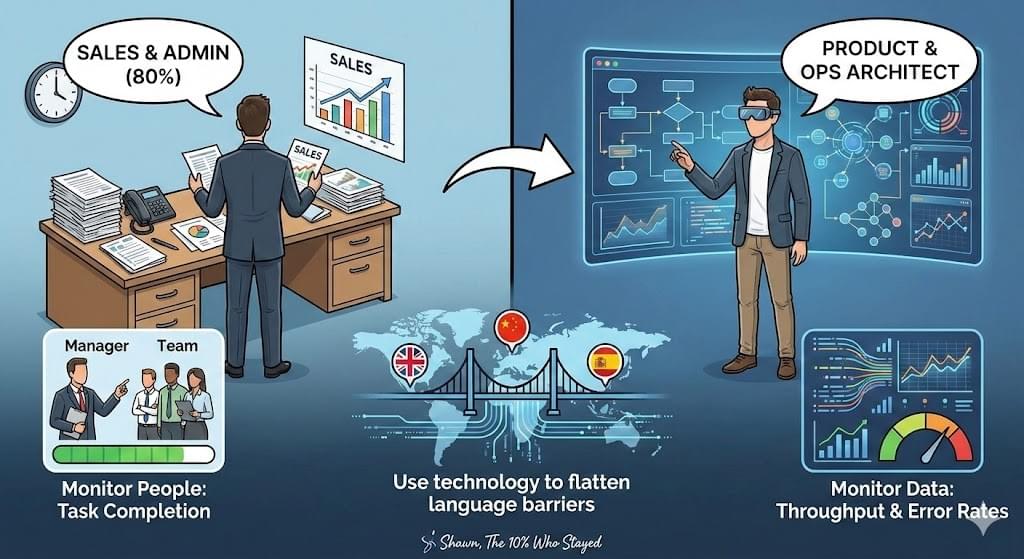
As a CEO, I used to spend 80% of my time on sales and administration. But in recent years, I’ve evolved into a "Product Manager" and "Operations Architect."
Managing a global, multilingual team of 60+ people is no longer about monitoring people; it’s about monitoring data. We need to shift focus from "Task Completion Rates" to "Throughput" and "Error Rates."
I remain an entrepreneur at heart, but I view myself more as an "External Partner" to my clients' internal teams. Whether driving workflow transformation within Translia or helping clients optimize their global expansion strategies, my goal remains unchanged:
To use technology to flatten language barriers, allowing value to flow seamlessly across the globe.
The future of localization belongs to the long-termists who dare to uphold the baseline of quality amidst the flood of algorithms. I am Shawn, and I am part of the 10% who stayed after the tide receded.