
AI Translation Is Hot, But People Are Confused
In 2026, AI translation has moved from "concept" to "infrastructure."
DeepSeek, ChatGPT, Kimi... domestic AI models are flourishing, and translation has become a "zero-threshold" skill. Anyone can open any AI tool, input some foreign text, and get a decent-looking translation.
Businesses now face suddenly more choices.
Previously, using a translation company was the only option. Now:
- Use AI to translate yourself
- Use DeepL and similar tools
- Hire a translation company
- Use AI translation + human review
Every option has its advocates and merits.
But what many people are truly confused about is: Which should I choose?
Let's Be Realistic: AI Translation Isn't Zero Cost
First, a misconception needs clarifying:
AI translation isn't free.
On the surface, AI translation tools don't charge money. But for scaled, batch usage—tens of thousands of words per month, multiple projects running simultaneously—token costs become significant.
1. Data Cost
To make AI translate well in specific domains, you need to feed it sufficient high-quality bilingual data. Automotive, legal, medical, finance—each field has its own terminology system and expression logic.
But here's a common cognitive bias: without professional data feeding, AI-translated content actually reads "not bad"—grammatically smooth and naturally expressed. The problem is—it may make errors you can't detect.
For example:
Your product has a proper noun: "智慧座舱4.0" (Smart Cockpit 4.0)
AI doesn't know this term, might translate it as "Smart Cockpit 4.0" or "Intelligent Cabin 4.0"
Reads perfectly fine, but your internal standard is "Smart Digital Cockpit"
— This type of error is hard to spot but creates brand inconsistency
2. Tuning Cost
AI models need "tuning." How to write prompts, set parameters, format outputs—these all require professionals. Someone without translation background using AI versus a senior translator using AI can produce quality that differs by leaps and bounds.
3. Error Correction Cost
AI translation makes mistakes—this is well-known. But what many don't know:
AI makes mistakes differently than humans.
Human translators: usually miss translations, wrong translations—easy to spot
AI translation: might look completely right but mean the opposite—harder to detect
This means AI-translated content often require even more careful review.
What Businesses Actually Care About: Three Dimensions
Back to business choices. Since AI translation isn't "zero cost + zero risk," what do people actually care about?
We've observed thousands of projects and identified three dimensions:
💰 Price
This is the most intuitive dimension. AI translation is indeed cheap, some even free. For internal communications, reference materials—content that doesn't need public release—AI translation offers excellent cost performance.
✨ Quality
But when it comes to externally published content, businesses have higher quality requirements. Websites, ads, product manuals—these represent brand image. One mistranslated sentence could trigger a PR crisis. AI translation's "ceiling" is high, but its "floor" is unpredictable.
⚠️ Risk
This is the most overlooked dimension: Who takes responsibility when problems occur? Who bears the cost of deadline delays? Who stamps official documents? Translation isn't just "finish and done"—it involves accountability.
Where Human Translation Companies Add Value
This isn't about proving "AI translation doesn't work." It's about stating: AI translation and human translation services each have their own value.
🧠 1. Judgment
AI can translate, but judging "whether it's correct" is another matter.
Source: "我们的电池技术领先全球" (Our battery technology leads the world)
AI translation: "Our battery technology leads the world"
Problem: In English, "leads the world" could be ambiguous
These contextual traps require people with linguistic sense to judge.
🤝 2. Accountability
Problems can be traced to people.
This is hard for AI to replace. When an AI tool has a problem, who do you contact? The developer company? The model provider? Often no specific person is accountable.
But when a translation company has a problem, the project manager is right there.
🎯 3. Customization
Understanding specific business scenarios:
"This document is for German dealers—they care more about technical details."
"This document is for Middle Eastern agents—we need to be careful mentioning Israel."
These "only humans know" details determine the final translation quality.
No Standard Answer: Choose Based on Need
Therefore, there's no "one-size-fits-all" translation solution.
Different content suits different approaches:
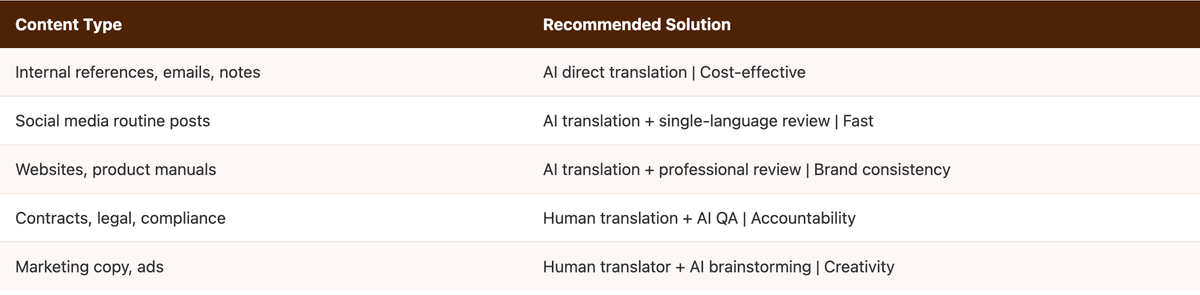
What businesses really need isn't "the best translation"—it's "the translation most suitable for their scenario."
Conclusion
The AI Agent era is refining division of labor in the translation industry.
AI's strengths (fast generation, batch processing) will become increasingly cheap.
Human strengths (judgment, creativity, accountability) will become increasingly valuable.
Translation companies shouldn't compete with AI on "who translates faster." They should compete with AI on "who judges more accurately."
This is what we're doing: using AI for efficiency, using humans for judgment. Giving businesses corresponding certainty for every yuan spent.
If you're thinking about multilingual content quality management, feel free to leave a message or reach out.
Translia - Empowering Brands Going Global
ISO 17100 & ISO 18587 Certified | 100+ Languages
translia.com | hi@translia.com